Politics
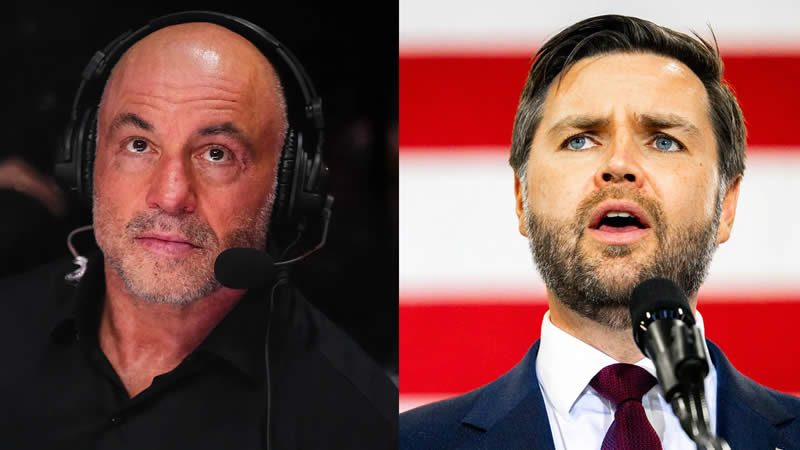
Joe Rogan calls parts of the MAGA movement “dorks,” sparking backlash and response from JD Vance

Podcast host Joe Rogan is once again at the center of a political debate after sharply criticizing parts of the Make America Great Again movement—an audience that previously overlapped with much of his fan base.
Rogan, who endorsed Donald Trump during the 2024 presidential election, has gradually taken a more critical tone toward the current administration and its supporters. His latest comments, delivered on a recent episode of The Joe Rogan Experience, quickly spread across social media and reignited conversation about his political stance.
While discussing political branding and grassroots movements, Rogan took aim at the MAGA slogan and what he believes it has evolved into.
“That phrase sucks. America is great. Make America greater? I’m down. But MAGA, and then it becomes a movement of a bunch of dorks?” Rogan said.
He continued, offering even harsher criticism of certain supporters within the movement. “A lot of them are these really weird, f-cking uninteresting, unintelligent people.”
Clips of the remarks circulated rapidly online, triggering a wave of reactions from both supporters and critics. Some listeners praised Rogan for openly criticizing political tribalism. Others accused him of turning against a movement that helped amplify his influence during the last election cycle.
On the social media platform X, one user questioned Rogan’s tone, writing, “When did Joe become an elitist? You only matter to Joe if you’re an amazing, accomplished, intelligent person.”
Another commenter suggested Rogan was gradually distancing himself from Trump entirely, posting, “Joe Rogan needs to stop dancing around it and just say it. Donald is a conman. There, fixed it for you, Joe.”
Other reactions focused less on politics and more on Rogan personally, with critics calling him inconsistent or hypocritical based on the wide range of controversial guests featured on his podcast.
The comments even caught the attention of Vice President JD Vance, who addressed the situation during an interview. Rather than escalating the dispute, Vance downplayed Rogan’s criticism with humor.
“I think we have many, fewer dorks than the far left, but everybody’s got some dorks,” Vance said with a laugh. “We love our dorks. We love our cool kids. We love anybody who wants to save the country.”
Rogan’s criticism of the MAGA movement comes during a period where he has been openly discussing political concerns on his podcast. In recent months, he has questioned several issues tied to the administration, including immigration enforcement, government transparency, and the handling of high-profile investigations.
Despite those criticisms, Rogan has repeatedly emphasized that he doesn’t see himself as loyal to either political party.
The podcast host has a long record of unpredictable political preferences. During the 2020 election cycle, he publicly supported Bernie Sanders. Over the years, he has described his political identity as independent and frequently criticizes both Democrats and Republicans.
In Rogan’s view, the American political system often leaves voters choosing between two flawed options.
His podcast discussions frequently move beyond partisan politics into broader policy ideas. Rogan has, at different times, expressed curiosity about proposals like universal basic income, infrastructure investment, and government-supported education programs.
However, he has also made it clear that his support depends heavily on how effectively those policies are implemented.
“I’ve always, I’ve said, hey, maybe we should look into universal basic income,” Rogan said during a previous episode.
He continued, “Maybe we should look into universal healthcare, we should fix the roads and we should fix intercities, if I thought my tax dollars were being used very appropriately in that way, I’d be 100% in favor of all that stuff.”
With millions of listeners tuning in to The Joe Rogan Experience each week, Rogan remains one of the most influential voices in modern podcasting. His willingness to criticize both sides of the political spectrum continues to make his commentary unpredictable—and frequently controversial.