Politics
“Republicans Are Pulling Away”: Trump’s Approval Falls as Voter Frustration Builds Nationwide

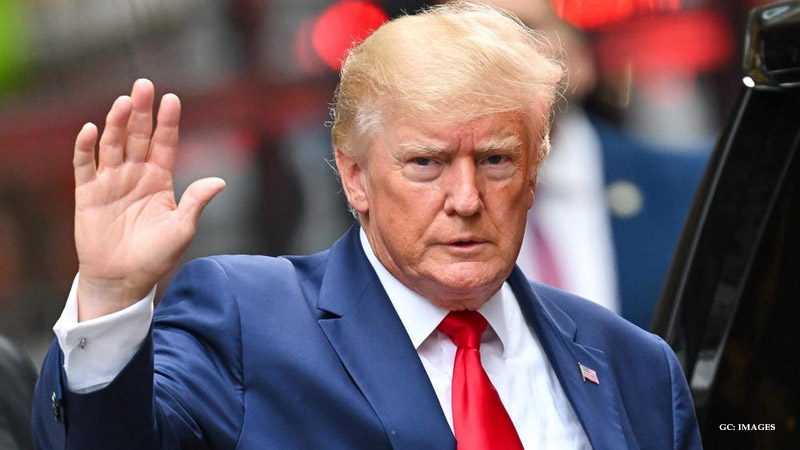
A recent national survey from Emerson College Polling found that 41 % of voters approve of the job Donald Trump is doing in office, while 49 % disapprove. That’s a four-point drop in approval from October, when it stood at 45 %. His disapproval ticked up one point, from 48 % to 49 %.
“Nearly one year after he was elected, President Trump’s approval has flipped since the first Emerson College poll of the new administration,” said Spencer Kimball, executive director of Emerson College Polling. “Since his inauguration, Trump has lost support among key groups: Republican voters’ approval decreased 12 points from 91 % to 79 %, and his disapproval intensified among independent voters, from 44 % to 51 %, and Hispanics, from 39 % to 54 %.”

The poll also asked about the generic 2026 congressional ballot. On that front, Democrats have a four-point lead over Republicans, 44 % to 40 %. Sixteen percent of voters said they were undecided.
Motivation to vote also came up strong: 57 % of respondents say they are more motivated to vote compared to a usual midterm year, 12 % said they’re less motivated, and 31 % said their motivation is about the same. Kimball pointed out that “Democrats report being most motivated to vote in the 2026 Midterm Elections, at 71 %, compared to 60 % of Republicans, and 42 % of independents.”

Interestingly, even though Democrats appear more energized, they aren’t viewed more favorably. Only 35 % of voters say they have a favorable view of the Democratic Party, while 44 % say they view the Republican Party favorably. On unfavorability ratings, 44 % are unfavorable toward Republicans and 47 % hold an unfavorable view of Democrats.
When asked why they’ll vote in the 2026 midterms, 43 % of voters say their vote will express opposition to President Trump, while 29 % say they’ll vote in support of him, and 28 % say Trump isn’t a factor in their decision.
The poll dove into issue priorities too. Seventy-five percent of voters said the economy is “very important” in their vote decision. That was followed by threats to democracy at 61 %, immigration at 59 %, housing affordability at 57 %, and abortion at 46 %.
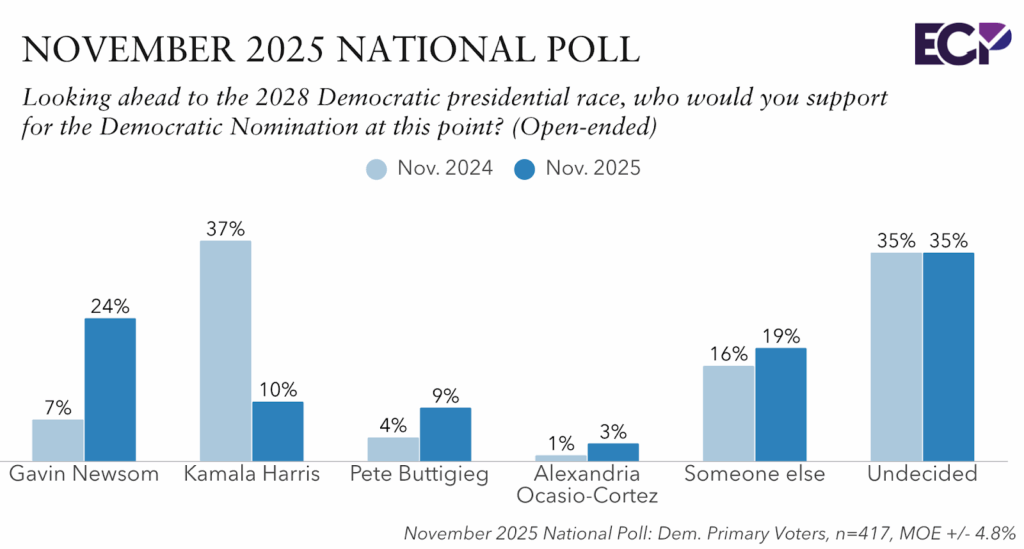
It even went ahead and looked at the early terrain for the 2028 presidential nominations. For the Democrats it’s Gavin Newsom leading with 24 %, followed by Kamala Harris at 10 % and Pete Buttigieg at 9 %. Others mentioned include Alexandria Ocasio‑Cortez and Josh Shapiro each at 3 %, Andy Beshear at 2 % and JB Pritzker at 2 %. Thirty-five percent said they’re undecided.
On the Republican side, a majority of GOP voters said they support JD Vance (54 %), while 7 % chose Trump, 6 % chose Marco Rubio, 2 % chose Ron DeSantis and 6 % selected someone else. Twenty-five percent are undecided.
The survey was conducted November 3-4, 2025 with a sample of 1,000 active registered voters and a credibility interval of plus or minus 3 percentage points. The data were weighted by gender, education, race, age, party and region to reflect U.S. Census and voter-file benchmarks. It’s worth noting that when you break results down by demographics like age, gender, or race the sample sizes shrink and the margin of error grows.
This portrait of shifting support and heightened voter motivation suggests that whatever happens in 2026 may be less about the usual partisan battle and more about how voters feel about Trump and how strongly each party can mobilize. While Trump still has a solid base, the cracks are showing—and for the Democrats the challenge will be turning motivation into wins.
For further context, you can check recent polling on Trump’s approval and voter attitudes. One recent national poll shows 41 % approve and 59 % disapprove of his job performance.